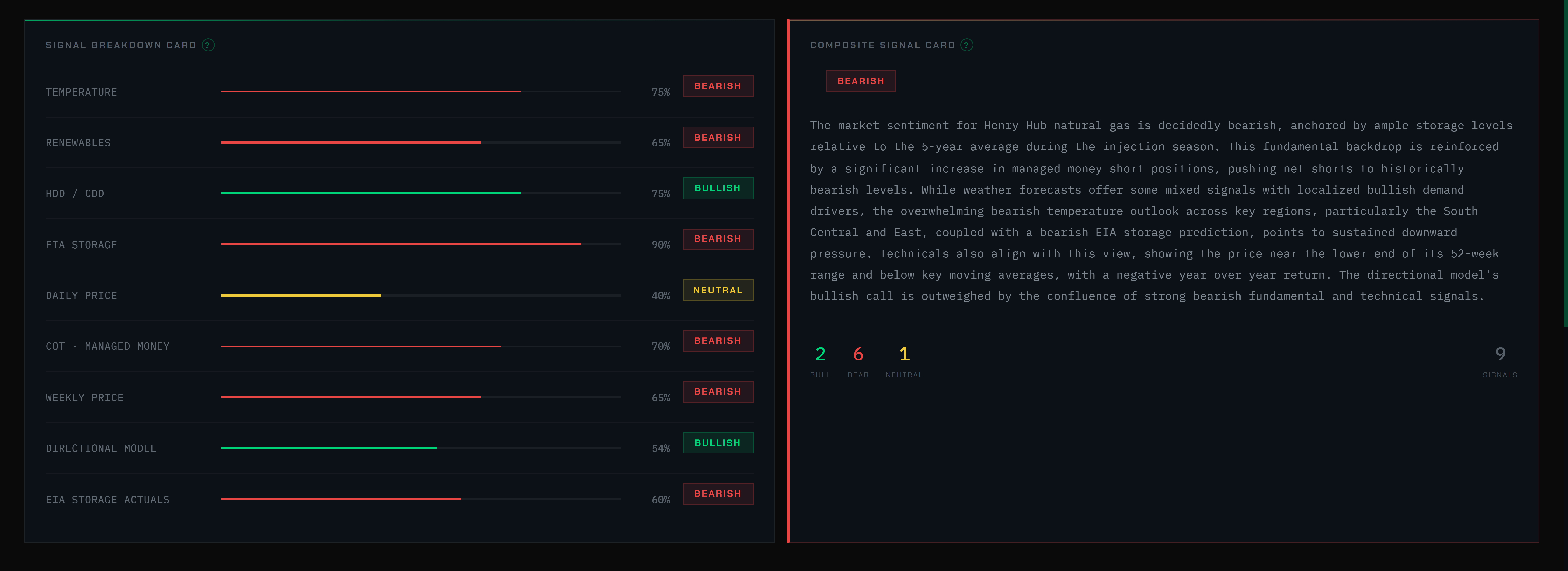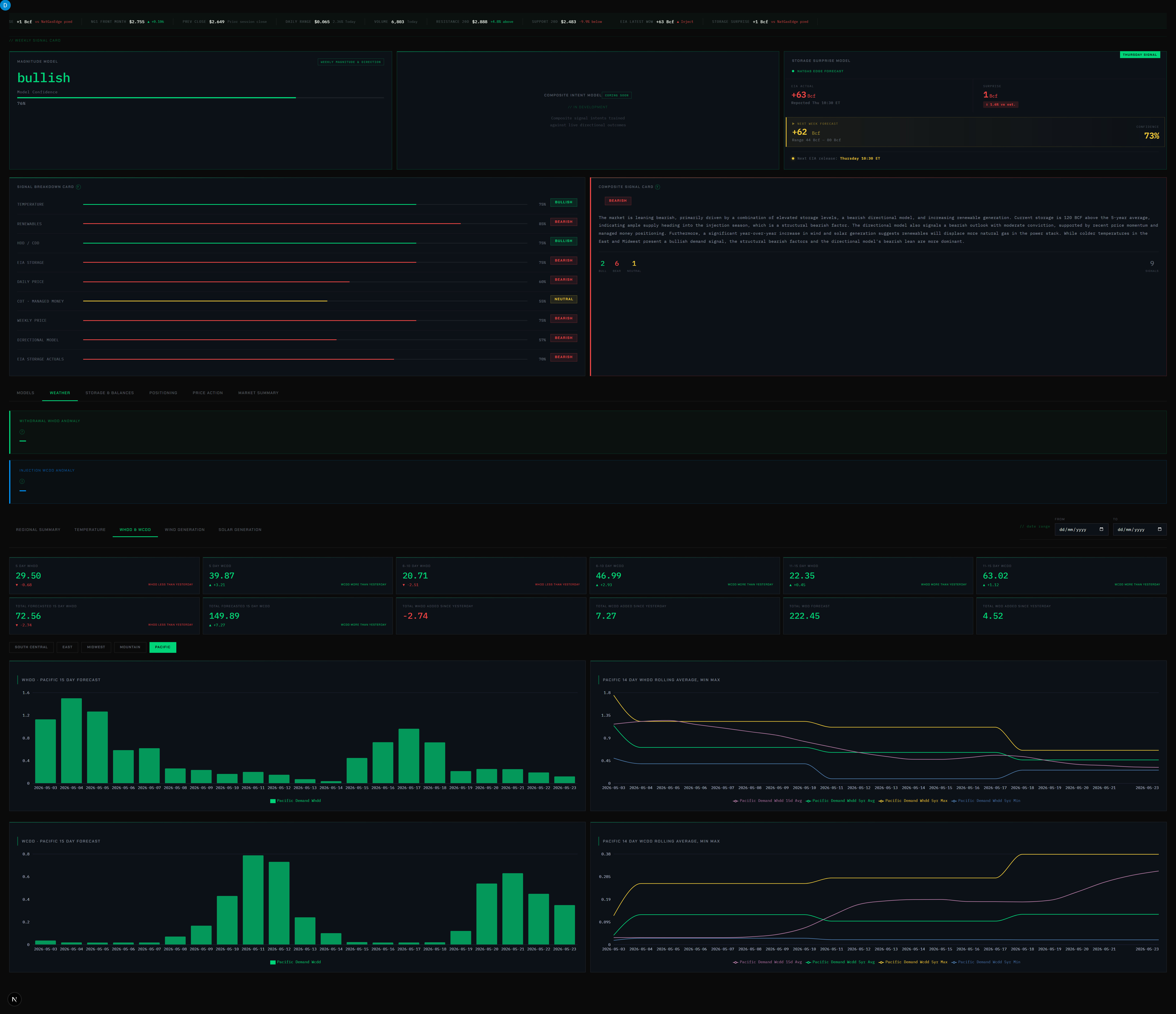
NatGas Edge is the research environment a serious nat gas trader would build for themselves if they had the time and engineering depth.
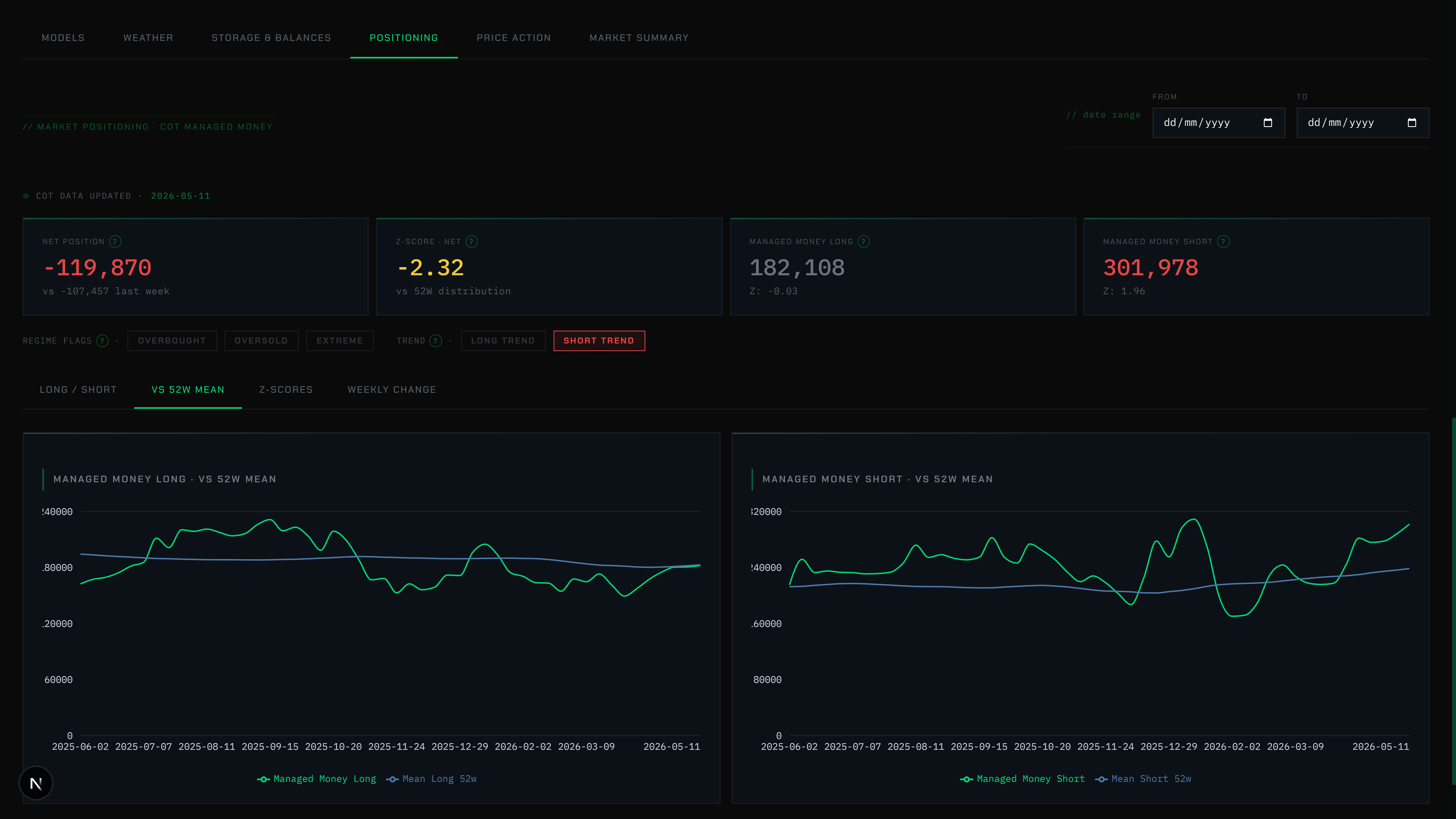
Every Henry Hub fundamental ingested daily and contextualised against sixteen years of history. Every forecast tracked through its revision history. Every metric displayed with seasonal percentile bands, z-scores against same-week distributions, and anomaly flags surfaced the day they fire.
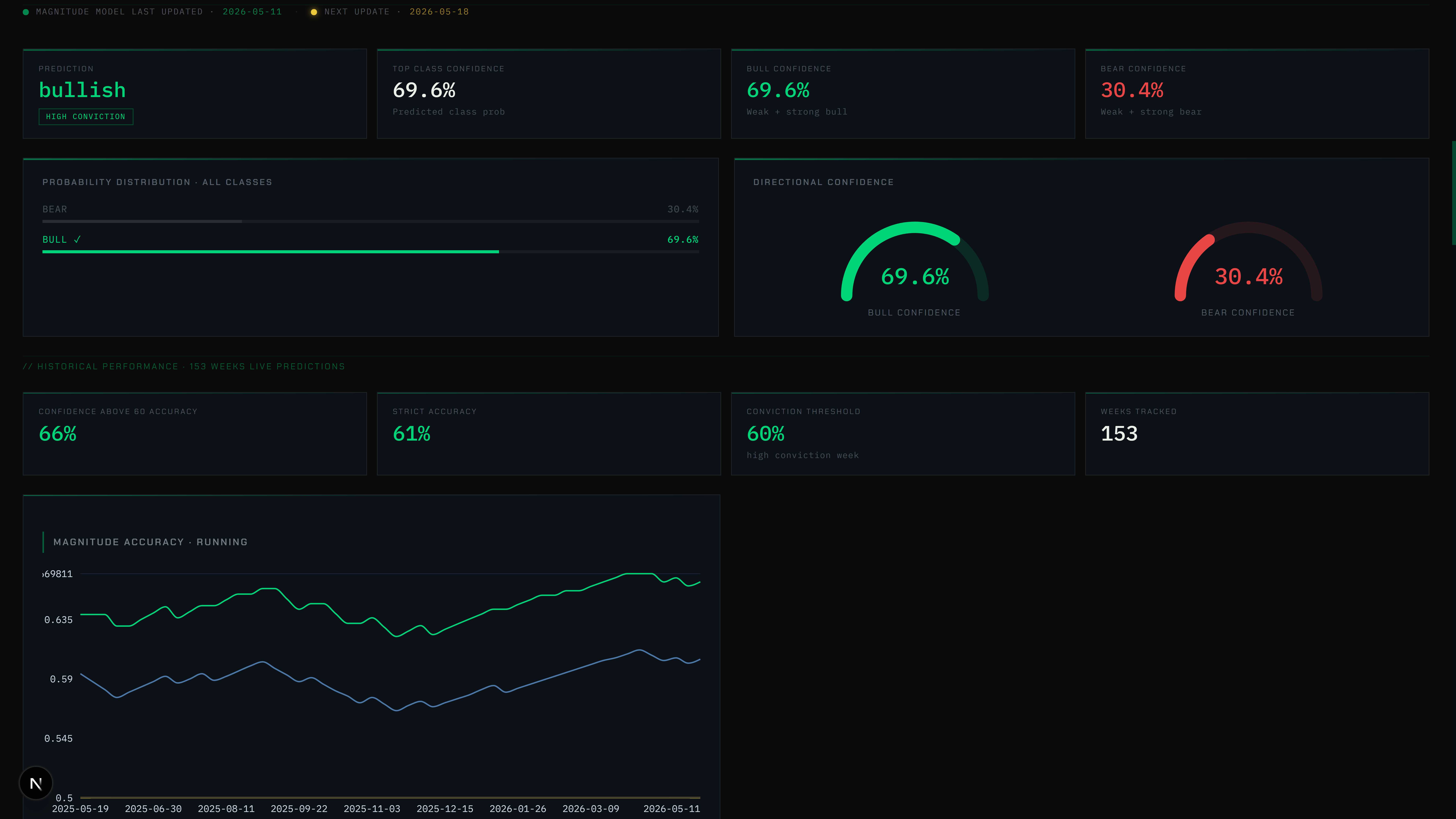
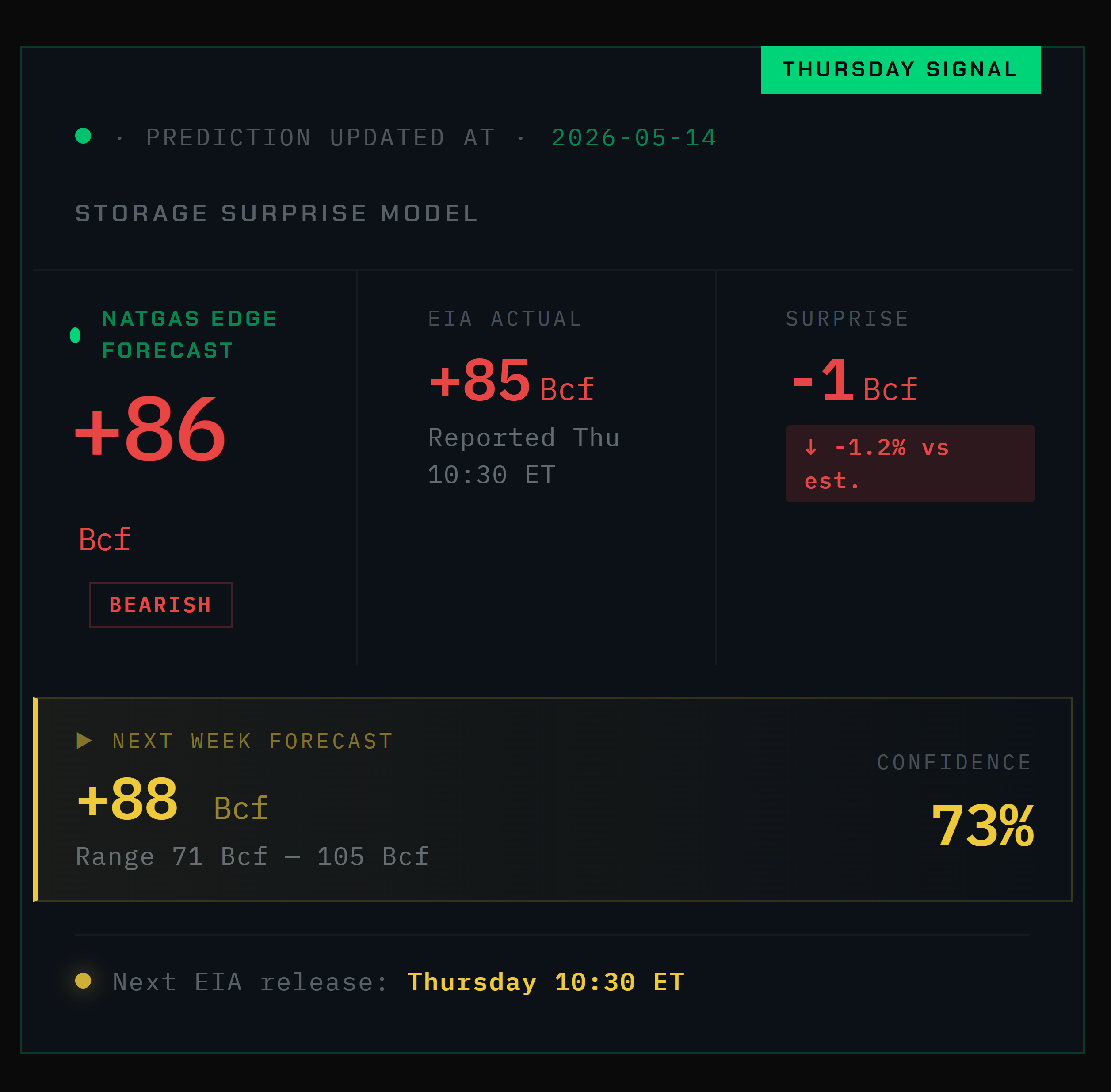
A directional model and a storage model on top of the data layer, both validated walk-forward across 156 weeks of out-of-sample predictions. The signals aren't the product — they're the synthesis of the product.
For analysts and serious traders who need to see the work, defend a view, or build their own on top.
Most retail platforms display whatever the latest forecast says, as if today's number is the only number that exists. But forecasts revise — daily, sometimes dramatically — and the revision itself often matters more than the absolute level.
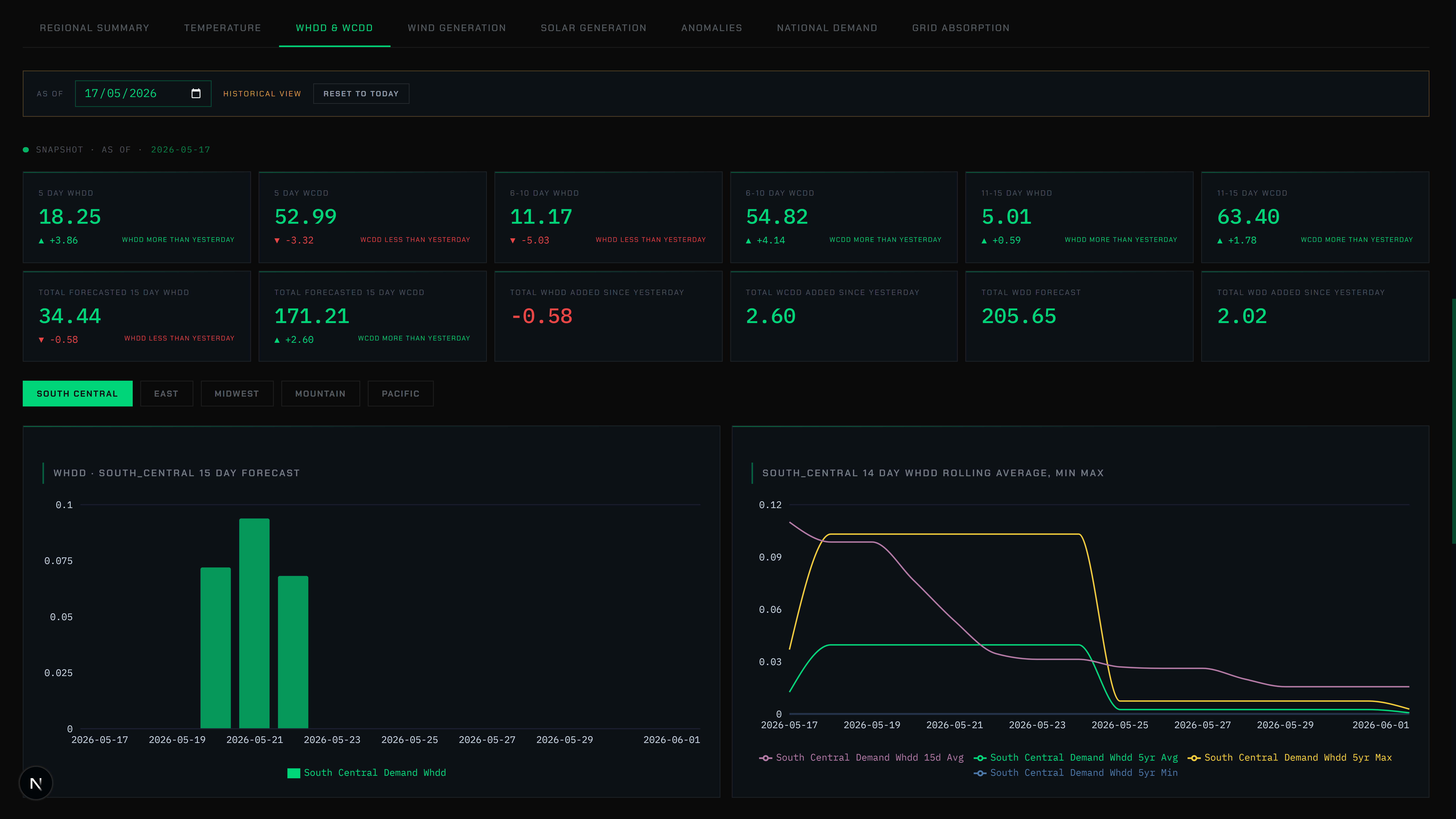
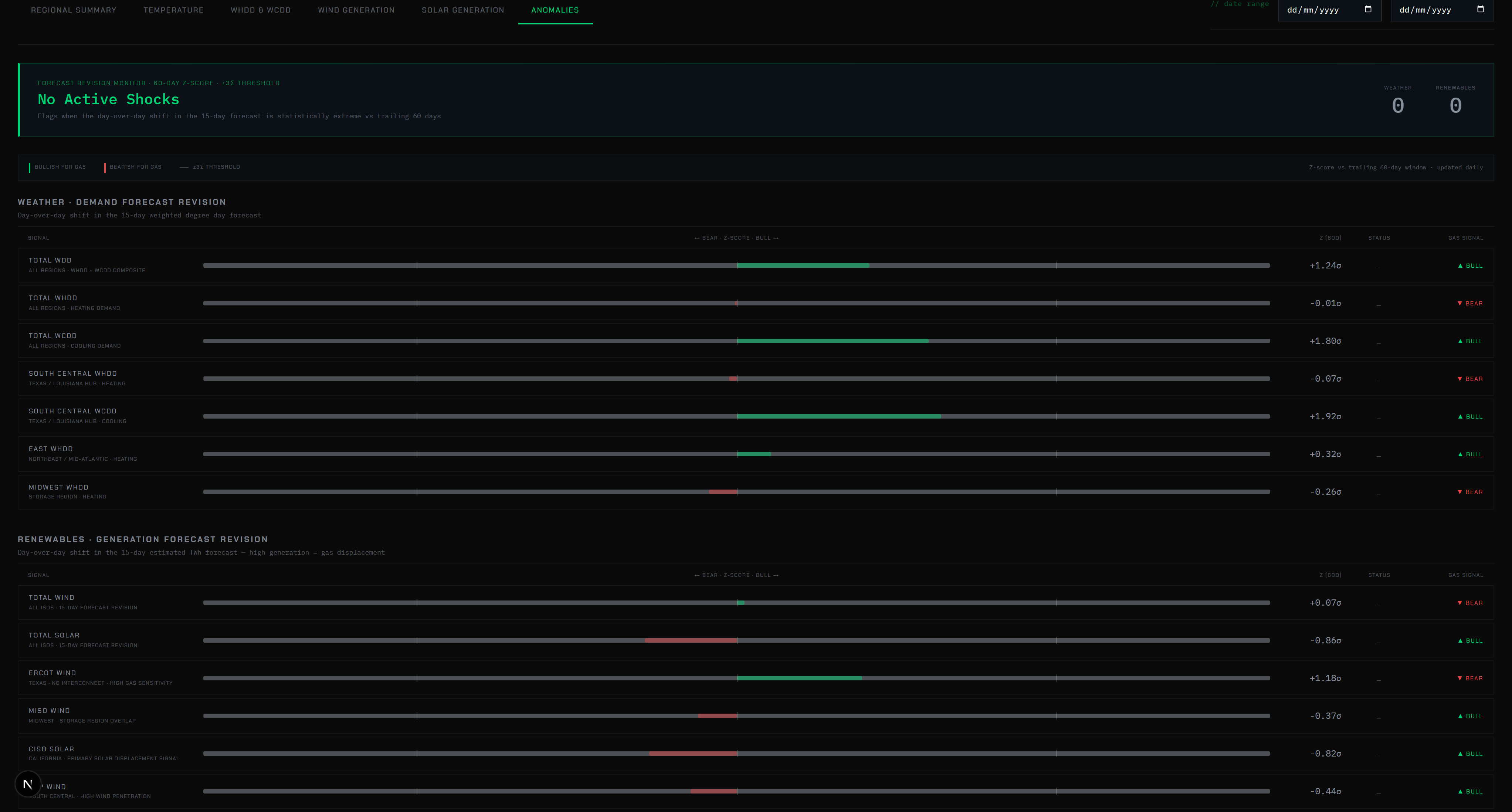
For every weather, renewables and storage forecast in the system, the day-over-day change is computed and z-scored against the trailing 60 days of revisions. A z-score beyond ±2σ means the forecast just shifted by more than it typically does — the model is updating on new information faster than usual. A cold-weather outlook that's been stable for a week is already priced in; the same outlook revised sharply colder overnight is information the market hasn't fully absorbed.
This is a unique capability layered across the platform, not a single feature. Wherever there's a forecast, there's a revision history beside it.
The Anomalies page consolidates every active forecast revision shock across the platform into one diagnostic view. Six tabs — Active, Weather, Renewables, Storage, Positioning, Price — each showing every z-score above the configurable threshold, with directional implications for gas marked bullish or bearish.
Beyond individual component shocks, the page surfaces compound patterns — multi-feature configurations measured against sixteen years of forward price data and only published when hit rate, mean return, and median return all beat baseline meaningfully on N≥30 historical instances. Each card displays the live trigger value alongside its measured historical context — what the configuration has done over the following ten days, every time it has fired since 2010.
An as-of date picker navigates the page back through history. Pick any date and the platform shows exactly what would have been visible that day — the same z-scores, the same shocks, the same compound flags. A time machine over the anomaly substrate.
Edge is the signal — a structured weekly read on Henry Hub fundamentals delivered after the Thursday EIA release. Built for traders who want the verdict and the headline numbers.
Intelligence is the platform underneath the signal — the full data layer, the forecast revision tracking, the anomalies page, the date-filtered seasonal context, the week-by-week out-of-sample track record. For analysts and serious traders who need to see the work, defend a view, or build their own on top.
Compared against £30k/yr institutional platforms, both tiers are launch-priced — Edge at 0.16% of an institutional contract, Intelligence at 0.8%. The difference is access, not depth.